Chandler Gallery is very pleased to present An American Narrative, an exhibition of mixed-media paintings by Berkeley-based artist Renée Bott, on view from February 7th through March 21st, 2026. This exhibition brings together several bodies of work in which Bott contemplates the cumulative and often contradictory history of the United States. Drawing from journals, novels, maps, and historical texts, particularly from the early American period, Bott weaves together fragments of the many voices that have contributed to the endlessly collaborative, and contested, story of America. Her work pays homage not only to well-known historical figures, but also to the animals and anonymous hands whose efforts quietly shaped a national identity.
Literature serves as both inspiration and material for Bott’s practice. Book pages form the figurative and literal armature of her paintings, grounding each work in language, narrative, and time. In her Atlantic Crossing paintings, Bott renders rolling, tumultuous seas across printed texts that recount the perilous journeys made from Europe to the Americas. The layered waves evoke both physical passage and psychological uncertainty, suggesting the courage, desperation, and hope embedded in these foundational crossings.
In Tools of the Trade, Bott overlays silhouettes of humble working instruments, axes, hammers, saws, onto Xeroxed maps, documents, and imagery from sixteenth-century sources. These works foreground labor and craftsmanship as essential, if often overlooked, forces in the making of a nation. The tools appear almost ghostlike, hovering between presence and absence, recalling the countless unnamed individuals whose work underpins American history.
Bott’s Women’s Work series honors forms of labor historically rendered invisible, addressing domestic, agricultural, and craft traditions through a lens that is both reverent and quietly political. The series draws inspiration from the artistic handiwork of women who embellished early American homes with hooked rugs, textiles made by pulling strips of fabric through a sturdy backing to create thick, looped surfaces. Originally born of resourcefulness, hooked rugs were crafted from recycled cloth and everyday materials, transforming humble remnants into richly patterned floor and wall coverings that brought color, comfort, and symbolic imagery into rural interiors. Bott echoes this tradition by layering her painted compositions over collaged book pages, much as these makers layered fabric to produce functional art. Bold motifs such as animals and florals, familiar in traditional hooked rug designs, connect the work to lived experiences of women whose creativity molded ordinary life into visual expression. In Women’s Work, Bott celebrates the ingenuity and craft of these makers and highlights the often-overlooked domestic arts that were pivotal in shaping early American visual culture and the collective stories we inherit.
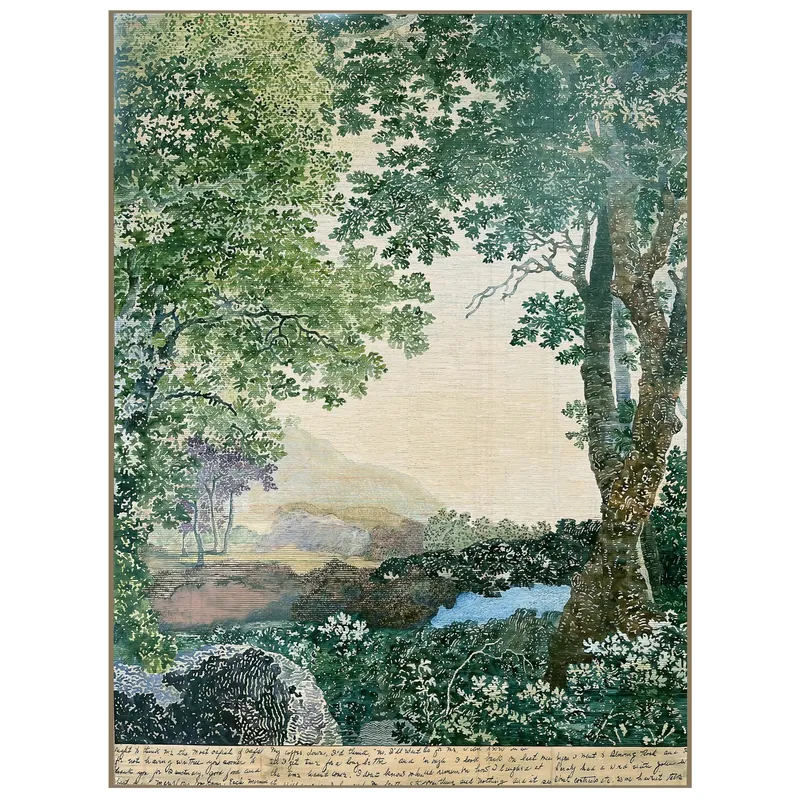
Bott also turns her attention to a later chapter of American history in the monumental Gone With the Wind (2025), painted directly over the pages of Margaret Mitchell’s novel . The lush, rambling landscape overtakes the text beneath it, suggesting the endurance and regenerative power of the natural world amid histories of human conflict, violence, and transformation. The work invites reflection on what narratives persist, which are obscured, and how meaning is rewritten over time.
Born in Ann Arbor, Michigan, and raised in Boston, Massachusetts, Renée Bott has always made and worked in art. She worked in fine art print publishing for over 30 years. For the past twenty years, she was a founding partner and Master Printer of Paulson Bott Press, a fine print atelier located in Berkeley, California. Here she worked with luminary artists such as Martin Puryear, Kerry James Marshall, and Tauba Auerbach. Renée specialized in facilitating the creation of complex and colorful intaglio prints within a traditional black-and-white medium. Paulson Bott Press has published over 500 editions, working with many artists. In 2016, the archive of Paulson Bott Press was acquired by the deYoung Museum in San Francisco.